EOT crane duty
classes, explained.
Two cranes with identical capacity and span can differ in price by half — the difference is duty class. This guide explains what the A3–A8 classes actually encode, how class drives cost, and how to land on the right one for your plant.
The most consequential
line on the spec sheet.
Capacity gets all the attention. Duty class quietly decides whether the crane is still reliable in year fifteen.
When plants specify an EOT crane, the conversation usually starts and ends with three numbers: safe working load, span and height of lift. All three are necessary; none of them describes how hard the crane will actually work. A 10 MT crane that makes six lifts a day in a maintenance bay and a 10 MT crane that feeds a fabrication line forty times an hour are, structurally and mechanically, different machines — even though both spec sheets say "10 MT".
Duty class is the single line that captures that difference. It sets the fatigue design of the girders and welds, the thermal rating of the motors, the sizing of gearboxes and brakes, and ultimately the crane's designed working life. Get it right and the crane runs for decades with routine maintenance. Get it wrong in either direction and you pay — in premature cracking and downtime if you under-specify, or in capital, wheel loads and building steel if you over-specify. In our experience it is the most common serious error in crane enquiries, ahead of span and headroom mistakes.
Load spectrum ×
operating cycles.
Indian crane practice — IS 3177 for electric overhead travelling cranes, with structural design to IS 807 — classifies a crane by combining two independent measurements of its working life:
Class of utilisation: how many operating cycles the crane will perform over its design life. A cycle is one complete lift-move-lower-return sequence. Six lifts a day for twenty-five years and forty lifts an hour across three shifts differ by two orders of magnitude — the classification counts them.
State of loading (load spectrum): how heavily loaded those cycles are. A crane that mostly lifts at a quarter of rated capacity and occasionally at full load has a light spectrum; a scrap-charging crane at or near rated load on nearly every cycle has a heavy one. Fatigue damage grows disproportionately with load, so the spectrum matters as much as the count.
The combination of the two maps to a group classification for the crane as a whole — A1 at the lightest end through A8 at the severest. Classes A3 through A8 cover practically all industrial EOT cranes, which is why our range is specified in those terms: single girder cranes at A3–A5 and double girder cranes at A4–A8. You will still meet older nomenclature — Class I to IV in earlier Indian practice, and M-numbers for individual mechanisms such as hoists — but the A-series class for the whole crane is what a modern general arrangement drawing carries.
The point to hold onto: duty class is not a quality grade. An A3 crane is not a worse crane than an A6 crane — it is a crane designed for a different job. Paying for A6 endurance in an A3 application buys nothing you will ever use.
Where typical
plants land.
The table below shows where common applications typically classify. Treat it as a starting point, not a verdict — the classification is always confirmed from your actual cycle counts and load profile.
| Class | Typical Application | Duty Pattern |
|---|---|---|
| A3 | Light workshops, maintenance bays, machine erection | Occasional lifts, rarely near rated load; crane idle most of the shift |
| A4 | Medium fabrication shops, general engineering | Regular lifts through the shift; mixed load spectrum with idle periods |
| A5 | Warehousing, machine shops, busy fabrication lines | Frequent lifts, often multi-shift; fair share of lifts near rated load |
| A6 | Steel and scrap handling, heavy continuous production | High cycle counts every shift; heavy spectrum, grab or magnet duty common |
| A7 | Clinker handling, melt-shop support, severe process duty | Near-continuous cycling at heavy loads in punishing environments |
| A8 | Foundry ladle cranes, scrap charging, round-the-clock process cranes | Severest continuous duty; hundreds of cycles per day at or near rated load |
Where the class
becomes steel.
How class turns
into rupees.
Duty class is not a paperwork attribute — it is physically built into nearly every major assembly, which is why two same-capacity cranes can carry very different prices:
Motors and drives. A higher class means more starts per hour and longer running periods, so motors are selected with heavier thermal ratings and duty margins, and variable frequency drives become standard rather than optional. The electrical package grows in step — contactors, resistors or drives, festoon and panel are all rated for the switching frequency the class implies.
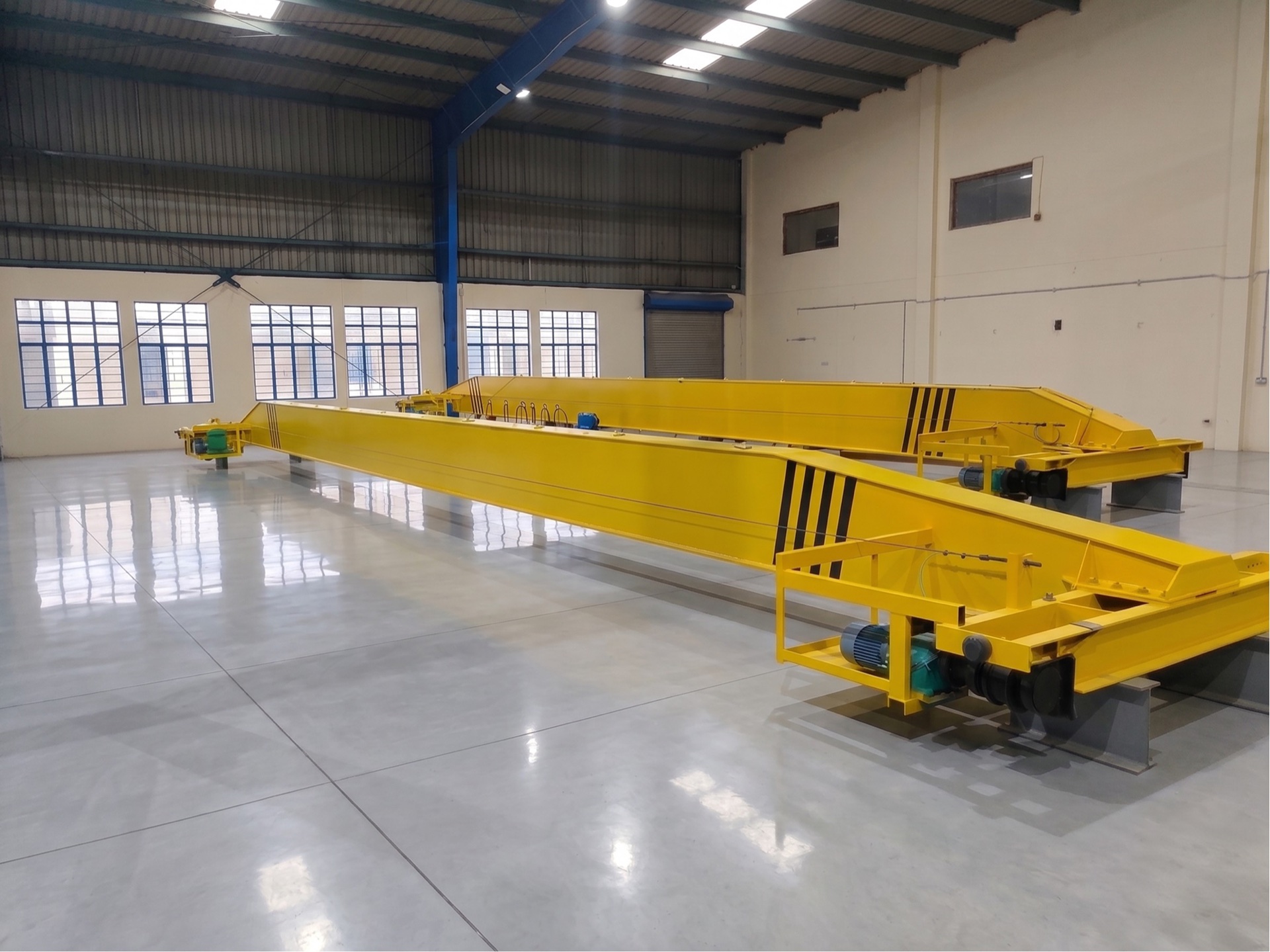
Girder section and welds. Fatigue governs high-class structures. Girders carry thicker webs and flanges, stiffener spacing tightens, and weld details are designed and inspected for cyclic loading rather than static strength alone. This is the largest single driver of weight and cost — and it is the one thing that can never be retrofitted.
Wheels, end carriages and wheelbase. More cycles mean more wheel passes over the rail. Higher classes get larger-diameter wheels, harder treads, heavier end carriage sections and — on heavy cranes — eight-wheel bogies to spread the load. The runway feels this too: wheel loads size the rail and the building's crane columns.
Brakes and gearboxes. Braking energy per shift scales with cycles and load. High-class cranes carry generously sized electro-mechanical brakes with faster wear parts replacement intervals designed in, and gearboxes rated for the transmitted power at the actual duty rather than a catalogue average.
As a rough orientation from our own build history: moving one class up typically adds a noticeable single-digit to low-double-digit percentage to crane cost at the light end, and considerably more at the top of the range, where A7–A8 construction, cabins and drive packages compound. Moving up two classes usually justifies re-examining whether the operation genuinely needs it.
Under-specified,
over-specified — both cost you.
Under-specifying is the expensive mistake. A crane run beyond its class accumulates fatigue damage faster than its design assumed. The symptoms arrive in a recognisable order: brake linings and contactors wear out ahead of schedule, motors run hot and eventually burn out, gearboxes develop noise, and finally cracks appear at girder welds and end carriage connections — at which point the crane is a structural liability, not a maintenance item. The plant pays through unplanned downtime on the one machine everything else in the bay depends on, and the "saving" made at purchase is gone many times over.
Over-specifying fails more quietly. The obvious cost is capital — you pay for endurance that is never used. The hidden costs sit in the building: a heavier crane means higher wheel loads, which means heavier rails, bigger runway beams and stronger columns, and a deeper girder eats headroom that the shed then has to provide. On a new build, one class of unnecessary margin can ripple into the civil and structural budget at multiples of the crane price difference.
The discipline that avoids both: classify from measured or honestly estimated duty — lifts per hour, shift pattern, load spectrum — then add margin only for concrete, planned growth, not for vague comfort. That is exactly the review our engineering team runs on every crane enquiry before a drawing is issued.
What IS 807 covers,
what IS 3177 covers.
The two standards are complementary, and a compliant crane needs both:
IS 3177 is the code of practice for electric overhead travelling cranes and gantry cranes. It is the standard the crane as a machine is built and tested against — covering the mechanical, electrical and safety requirements of the crane and its mechanisms, and the duty classification framework this article has been describing. When a specification says "crane to IS 3177, class A5", it is invoking this document.
IS 807 is the code of practice for the design, fabrication, erection and testing of the structural steelwork in cranes — the girders, end carriages and structural connections. It governs how the structure is analysed and proportioned for the loads and the fatigue life the duty class implies, including limits such as allowable girder deflection.
In practice the two work as classification and consequence: the duty assessment fixes the class, and the structural design to IS 807 plus the mechanism and electrical design under IS 3177 deliver a crane built to endure it. Every Fluidline crane is designed to both, load tested before dispatch — static at 125% and dynamic at 110% of rated capacity — and shipped with the test certificates and traceability records that statutory inspection under the Factories Act requires.
Duty class
questions.
Which duty class does a typical fabrication shop need?
Can a crane be upgraded to a higher duty class later?
Does a higher duty class mean a slower crane?
What documents certify the duty class of a crane?
What information does Fluidline need to classify my crane?
Not sure of your
class? Send the numbers.
Lifts per hour, shift pattern, load profile, span and headroom — that is all our engineering team needs to classify the duty, size the crane and return a general arrangement drawing with a quote.