Orange peel vs
clamshell grab:
how to choose.
Two grab families, two completely different working principles. This guide sets out the engineering logic — material geometry, density, penetration, spillage and cycle time — so you can specify the right grab the first time.
Tines wrap.
Shells scoop.
Every grab selection question reduces to one property of the material: does it flow, or does it interlock?
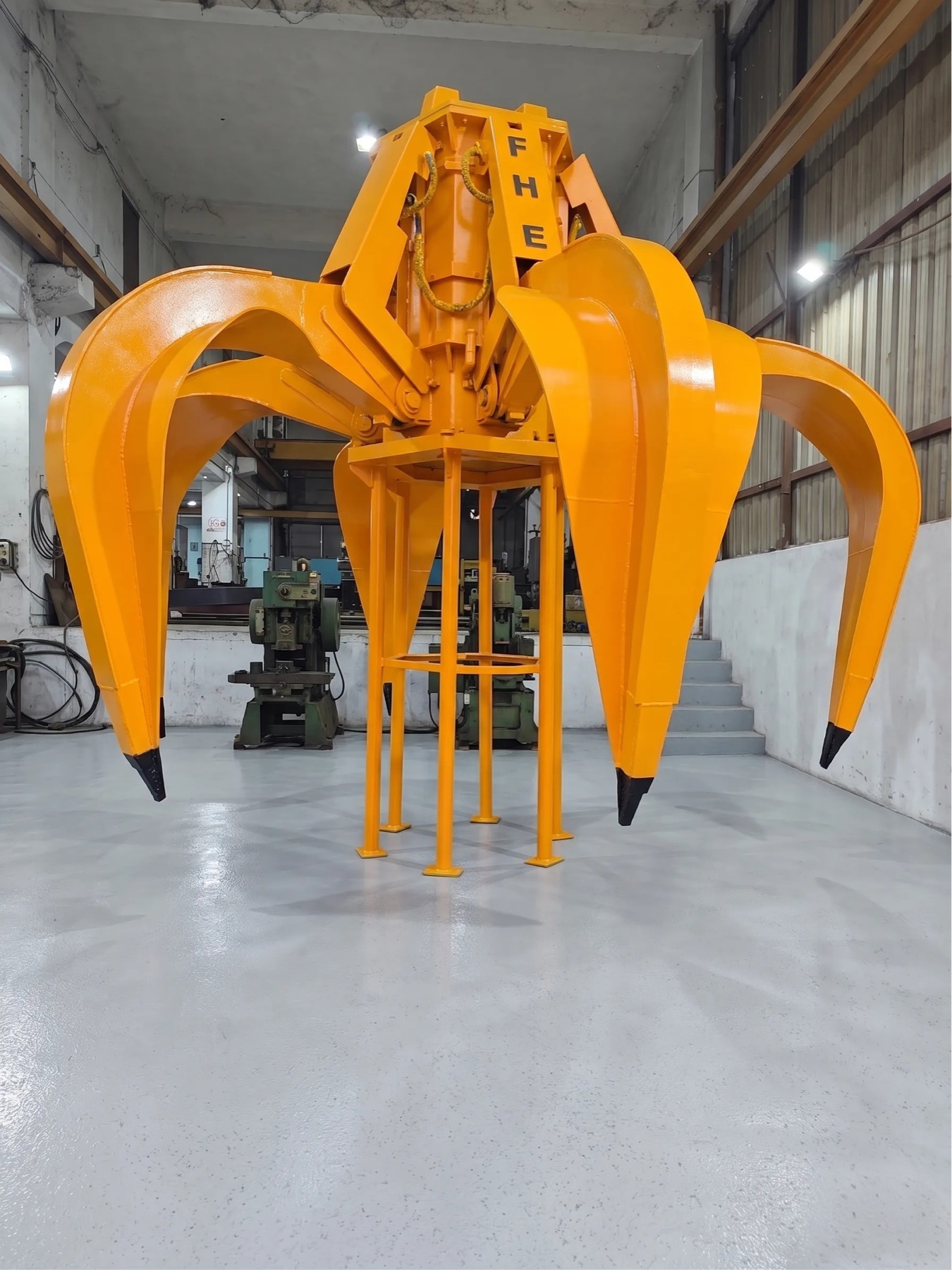
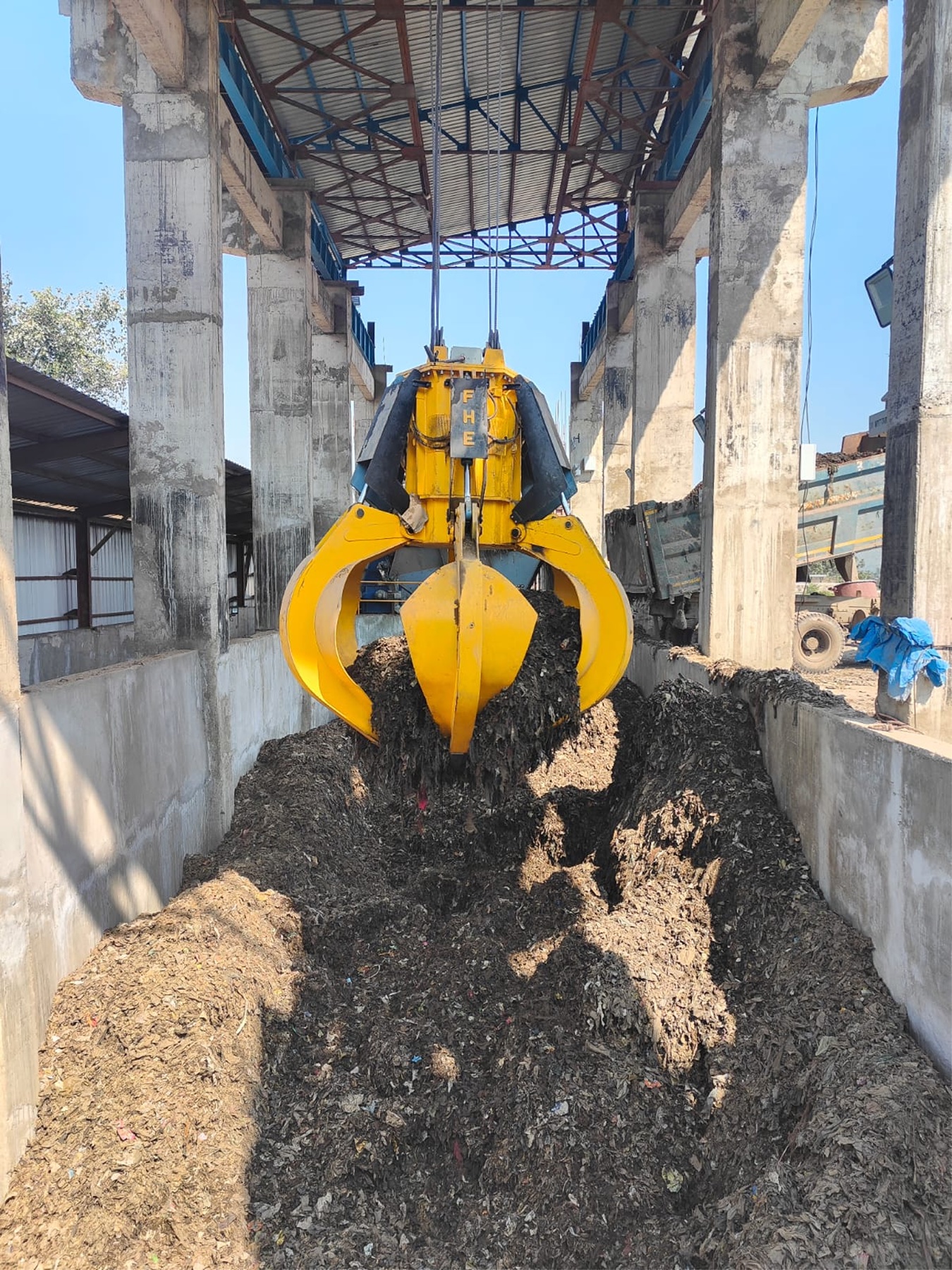
An orange peel grab closes four to six curved tines around the load, the way a hand closes around a bunch of keys. The tines penetrate between pieces, hook under them and wrap the load against the grab body. That geometry is exactly what irregular, interlocking material needs — steel scrap, demolition debris, slag lumps, mixed waste. The pieces bridge across the tines and lock each other in place, so retention improves as the material gets more awkward.
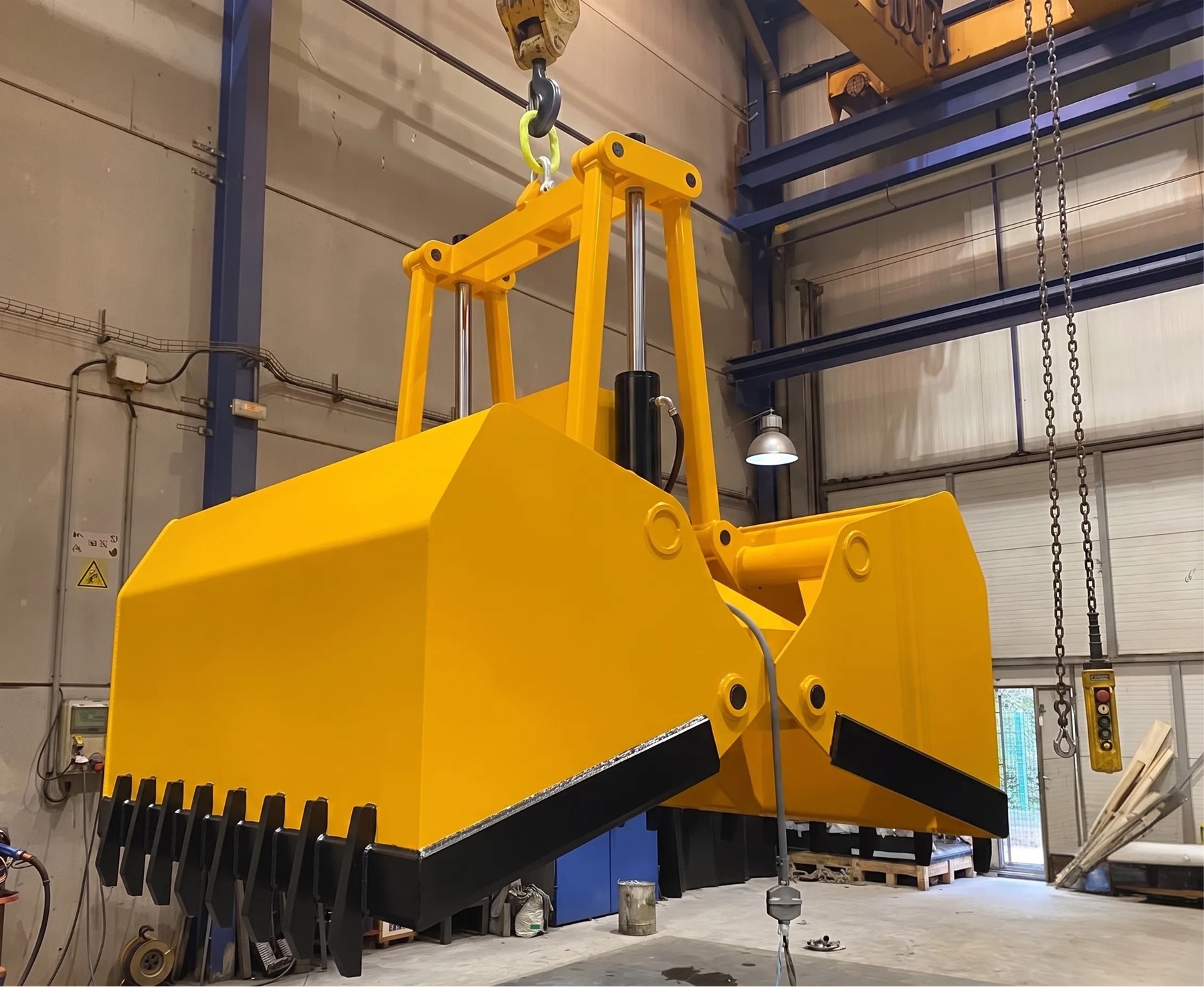
A clamshell grab does the opposite. Two continuous shell plates swing together and meet at a parting line, forming a near-closed bucket. Nothing penetrates and nothing wraps — the shells simply scoop a bite out of the pile and hold it the way a bucket holds water. That is exactly what free-flowing granular material needs: grain, coal, sand, ore, aggregate, fertiliser. The material takes the shape of the shells and stays put because there is nowhere for it to escape.
Swap the two and both fail, in opposite ways. A clamshell on scrap cannot penetrate the pile and cannot close around protruding pieces — it comes up part-full with the shells jammed apart. A peel grab on grain penetrates beautifully and then pours its load out through the tine gaps on the way to the hopper. The material decides the grab. Everything else — capacity, tine count, shell geometry, crane interface — is sizing.
Match the grab
to the material.
The table below covers the materials we are asked about most often. Bulk densities are indicative loose values — always confirm against your own material, because density drives both grab payload and crane loading.
| Material | Typical Loose Density | Recommended Grab | Tine / Shell Notes |
|---|---|---|---|
| Steel scrap (HMS, mixed) | 0.7–1.0 t/m³ | Orange peel | 4 or 5 tines; Hardox tines for penetration into compacted piles |
| Demolition debris | 1.2–1.6 t/m³ | Orange peel | 4 tines with heavy sections for large concrete and structural pieces |
| Slag | 1.4–1.8 t/m³ | Orange peel | 5 tines; abrasion governs — wear-resistant steel is non-negotiable |
| Municipal solid waste | 0.3–0.6 t/m³ | Orange peel | 6 tines, close spacing; retention matters more than penetration |
| Grain (wheat, rice) | 0.6–0.8 t/m³ | Clamshell | Dust-sealed variant; close-fitting shells at the parting line |
| Sand & aggregate | 1.4–1.7 t/m³ | Clamshell | Replaceable wear lips; shell volume sized down for the density |
| Coal | 0.8–1.0 t/m³ | Clamshell | Larger shells pay off — volumetric capacity governs throughput |
| Iron ore | 2.0–2.5 t/m³ | Clamshell | Smallest shell volume per tonne; structure sized for the density |
| Sugarcane (whole stalk) | 0.2–0.4 t/m³ | Neither — cane grab | Long interlocking stalks need a dedicated cane unloading grab geometry |
Penetration
and retention.
Two mechanisms decide how much material actually arrives at the hopper: how well the grab gets into the pile, and how well it keeps what it caught.
Penetration is about pressure at the contact point. A tine tip presents a small contact area, so the grab's closing force concentrates into a high local pressure that drives the tip between interlocked pieces. Fewer, wider-spaced tines penetrate deeper for the same closing force — which is why heavy compacted scrap calls for a 4-tine configuration. A clamshell's cutting edge, by contrast, is a long straight lip: the same closing force spread across the full shell width. On granular material that is ample, because the pile offers almost no resistance; on scrap it is nowhere near enough, and the shells ride over the pile instead of biting in.
Retention is about closing the escape paths. A closed clamshell approaches a sealed container — for fines and grain, the dust-sealed variant closes the parting-line gap as well, and spillage per cycle approaches zero. A closed peel grab is deliberately not sealed: the load is held by tine overlap and by the material interlocking with itself. That works precisely because scrap pieces are large relative to the tine gaps. Push piece size down — shredded scrap, small castings, mixed light waste — and the gaps start to leak, which is the signal to move from 4 or 5 tines to a 6-tine close-spaced configuration.
Spillage is not just lost throughput. Material shed over the working area has to be cleaned up, damages what it lands on, and in a port or yard becomes a standing housekeeping and safety cost. When two configurations look equal on paper, the one that spills less usually wins on total cost within the first year.
The two families,
side by side.
Cycle time
& tonnes per hour.
Throughput planning is a short chain of multiplications, and it is worth doing before anyone quotes you a grab size:
Payload per cycle = grab volume × bulk density × fill factor. Fill factor — the ratio of actual fill to rated volume — is where optimism goes to die. A clamshell in free-flowing grain fills to 0.9 or better; an orange peel in mixed scrap typically achieves 0.6–0.8 depending on piece size and pile compaction.
Throughput = payload per cycle × cycles per hour. Grab actuation (open plus close) is 8–12 seconds on our standard hydraulic grabs, but the full cycle is dominated by crane travel — hoist, traverse, slew or long travel, and return. A realistic full cycle in a typical yard is 60–120 seconds.
| Worked example | 2.5 m³ orange peel grab, 5-tine, on mixed HMS scrap |
|---|---|
| Loose bulk density | ~0.9 t/m³ |
| Fill factor | 0.7 (typical for mixed scrap) |
| Payload per cycle | 2.5 × 0.9 × 0.7 ≈ 1.6 t |
| Full cycle time | 90 s (grab actuation + crane travel) |
| Cycles per hour | 40 |
| Throughput | ≈ 63 t/h |
Run the same numbers for your target tonnage and the required grab volume falls out directly. Then check the result against the crane: grab self-weight plus payload must sit inside the hook's safe working load with margin — and against the densest material the grab will ever see, not the usual one.
Five common
mis-specifications.
These are the errors we see most often in enquiries and site visits — each one avoidable at specification stage:
- Specifying a clamshell for "mostly" granular material. A yard that handles coal five days a week and demolition rubble on the sixth needs the grab decision made on the rubble, or a second grab. The occasional material breaks the grab, not the routine one.
- Sizing the grab by volume without checking crane capacity. A bigger grab moves more per cycle — until grab weight plus payload exceeds the hook's safe working load on dense material and the crane trips or, worse, is run overloaded.
- Ignoring fill factor. Quoted at rated volume, delivered at 0.6–0.7 fill on real scrap: throughput calculations built on rated volume miss by a third before the grab ever leaves the pile.
- Choosing tine count on capacity instead of piece size. Tine count follows the material's piece-size distribution — retention for small pieces, penetration for large ones. Capacity is set by volume and crane, not by tine count.
- Forgetting the hydraulic circuit. A hydraulic grab needs pressure and flow the crane may not have. Confirm circuit capacity — or budget a dedicated power pack, or specify a rope-operated clamshell — before ordering, not at commissioning.
Grab selection
questions.
Can a clamshell grab handle steel scrap?
Can an orange peel grab handle grain or other free-flowing material?
How do I choose between 4, 5 and 6 tines on an orange peel grab?
What crane capacity do I need for a given grab?
Can Fluidline retrofit either grab type to an existing crane?
Still deciding?
Send us the material.
Share your material type, piece size, bulk density if you have it, crane capacity and target throughput. Our engineering team will recommend the grab family, size and configuration — with the working behind it.